


Halloween, 2020.
The bug was out of control.
Across the world, infections spread like wildfire. France was in lockdown again. Brazil was digging mass graves. According to Johns Hopkins University, in the United States there were over 9 million cases reported since January, one million of which was added only in the last two weeks of October. The U.S. set a new record: 90,000 cases reported in one day. That was basically a new infection every second. Over 1,000 folks a day were dying. 230,000 Americans had succumbed to the virus. The autumn surge hadn’t just arrived; it came with a vengeance.
Bottom line, we didn’t want to initiate anymore lockdowns, quarantines, or shutdowns of commerce, more willing to let those of us more susceptible to the virus perish, to continue our preferred way of life.
Australia and New Zealand were leading the way in eradicating Covid. There were two primary reasons for that; they were island nations remotely located in the south Pacific, and they followed stringent quarantine and lockdown measures, requiring their citizenry and incoming travelers to abide by regulations to the fullest extent, enforceable by law. Legal consequences of pandemic protocol infractions were something we Americans steadfastly refused to put into play. After all those months of misery and partisan bickering, we still didn’t like being told no.
In California, massive spikes in gun sales and gun ownership occurred. A study out of the University of California at Davis showed that 110,000 people purchased a firearm because of the pandemic (47,000 of which were first time gun owners), and many gun owners polled admitted they had a firearm loaded and at the ready, not locked up and secured as in normal times. Most of those recent gun purchasers cited a fear of governmental collapse, pandemic-driven chaos, or social unrest in the streets as the primary reasons why they’d decided to buy a gun.
As a Socal boy, I realize I should’ve been more stoked (that’s right, I still say ‘stoked,’ told ya I was an 80s exile) about the Los Angeles Dodgers’ first World Series win since 1988 that last week in October. I didn’t watch any of the games in full. I followed the sports highlights at the end of the night. Baseball long ago lost its shine for me, I respect its rightful place in the American lexicon. I played Little League (poorly) when I was a kid. I’ve been to a number of Dodger games over the course of my life. You can’t really avoid hitting Dodger games in SoCal. Winning the pennant is something a Southern Californian dude should embrace and celebrate, just like we’re supposed to herald any Laker wins.
But because of the doom-tainted glasses I’d been wearing all year, all I could see after the Dodgers’ 3-1 victory over the Tampa Bay Rays in Game Six was American hubris on full display for the world to see. First in the actions of fans taking to Angeleno streets in mask-less mobs to celebrate the World Series win, and second in the decision of L.A. favorite son Justin Turner to return to on field victory celebrations after being removed in the eighth inning due to a positive Covid test result.
Turner basically said fuck it and ignored Major League Baseball’s agreed-upon pandemic protocols. While it’s obvious why Turner wanted to participate in the culmination of a blunted season soldiered through a global pandemic, a season in which he was an integral component in terms of getting the Dodgers to a World Series win thirty years in the making, the blatant disregard for others to accommodate a need for self-validation was a public confirmation of the status quo for Americans. He even took off his mask for the team photo for posterity. Fans were quick to point out it hardly mattered as he’d been playing among the other players and staff for the entire game, and if he’d infected anyone else, it was too little too late. Dodger star or not, his obligation as a human to surrender a desired need for completion, hard-won as it may have been, to not risk indirectly infecting others upon getting his positive test result remained a necessity despite the glory at hand.
Sacrifice our personal good for a greater good.
That’s what we’re supposed to be.
It’s what we pretend to be.
It wasn’t really his fault.
It was our fault.
All of us.
He wouldn’t have made that choice if it wasn’t already so common a choice.
If his decision was an anomaly rather than the rule.
Fame and glory beckoned and he figured it was worth the risk. Surely his teammates and fans thought the exact same thing. Yet if contract tracing backtracked any deaths to that decision, he would’ve regretted it. I’d have struggled with the decision to quarantine only two innings away from a World Series win that likely would be my only appearance in such a life altering game, a culmination of a sports career I’d worked hard to actualize. Obviously anybody would. Ultimately, I’d like to think I’d have decided the moment in the spotlight wasn’t worth how I’d feel if I discovered somebody died after contracting the disease from me.
Things are definitely worth taking risks in this life, don’t mistake me. I felt the same way when I hit Olvera Street in Los Angeles for a shopping trip, though I was masked, but if I’d inadvertently infected the shopkeeper and they died? Then my choice wouldn’t have been worth it. But Turner should’ve put forth the maximum effort in running the gauntlet by wearing a mask. Like I did.
In not observing pandemic protocols, we were making a choice for others, not just ourselves. No pennant was worth loss of life. Sports are an important part of American society. Yet they should not supersede the sanctity of life. Despite what many a fan might tell you. Nor should my preferred mass gathering, concerts. Live music feeds the soul. But if a live set was gonna kill someone unnecessarily…postpone the fucking tour already.
It all came down to the mortality rate.
If it reached 75%, people wouldn’t have blinked an eye about skipping a World Series celebration. Because it was so ‘low,’ (in that month, it appeared to be what seemed like a measly 3-6%, depending on sources). Thing is, 230,000 Americans dying of a virulent bug inside of 9 months was not incidental. I said early on it would probably take a Walking Dead kind of scenario for many Americans to take quarantine seriously enough to abide. You know…bodies uncollected on the streets, HAZMAT-suited soldiers roaming the streets, boarded-up hospitals, martial law.
Even if those of us who were being ‘overly cautious’ were wrong about the death rate and severity of the thing, we were still erring on the side of caution regardless of how many Americans had died. It didn’t matter if we ended up being wrong about the severity of contagion or efficacy. We still did what rational sentient life forms ought to do in that situation: treat an unknown virus with widely varying effects case to case, with no reasonable forecast as to long term effects on survivors, as a dire threat to all humanity. If even one life was lost due to a lack of empathy, that was one life too many. And it sure wasn’t a fair trade off for a sports game, a political rally, or a backyard BBQ, or a concert.
While we all mired in a legit dystopia, the media delivered unto us another dismal hand in showcasing a discovery of forced monkey labor.
Let me reiterate that.
Monkey slavery.
In that autumn of 2020, Costco and WalMart discontinued carrying Chaokoh brand coconut milk after PETA accused its manufacturer of using forced monkey labor. PETA investigators from its Asia division found cruelty to monkeys at farms and facilities used by Theppadungporn Coconut Company. Apparently when the monkeys weren’t being forced to pick coconuts or perform in tourist sideshows, they were chained to old tires, confined to small cages only as large as their bodies, and if they were non-compliant or showed resistance in defending themselves, their teeth were pulled out.
Yes, that was a thing. Let’s face it, it probably still is. Trained monkeys under indentured servitude assisting Asian corporations in harvesting alternative milk creamer for our chai lattes. The fact there’s monkey labor at all in our world says a lot about where we are as a species. That was something I didn’t really need to know. But I do, and thanks to me, so too, do you now as well. You’re welcome! Monkey slavery. For fuck’s sake. I stank of whiteboy naiveté, in my ignorance of the reality there were lower order simians collecting coconuts for higher order simians.
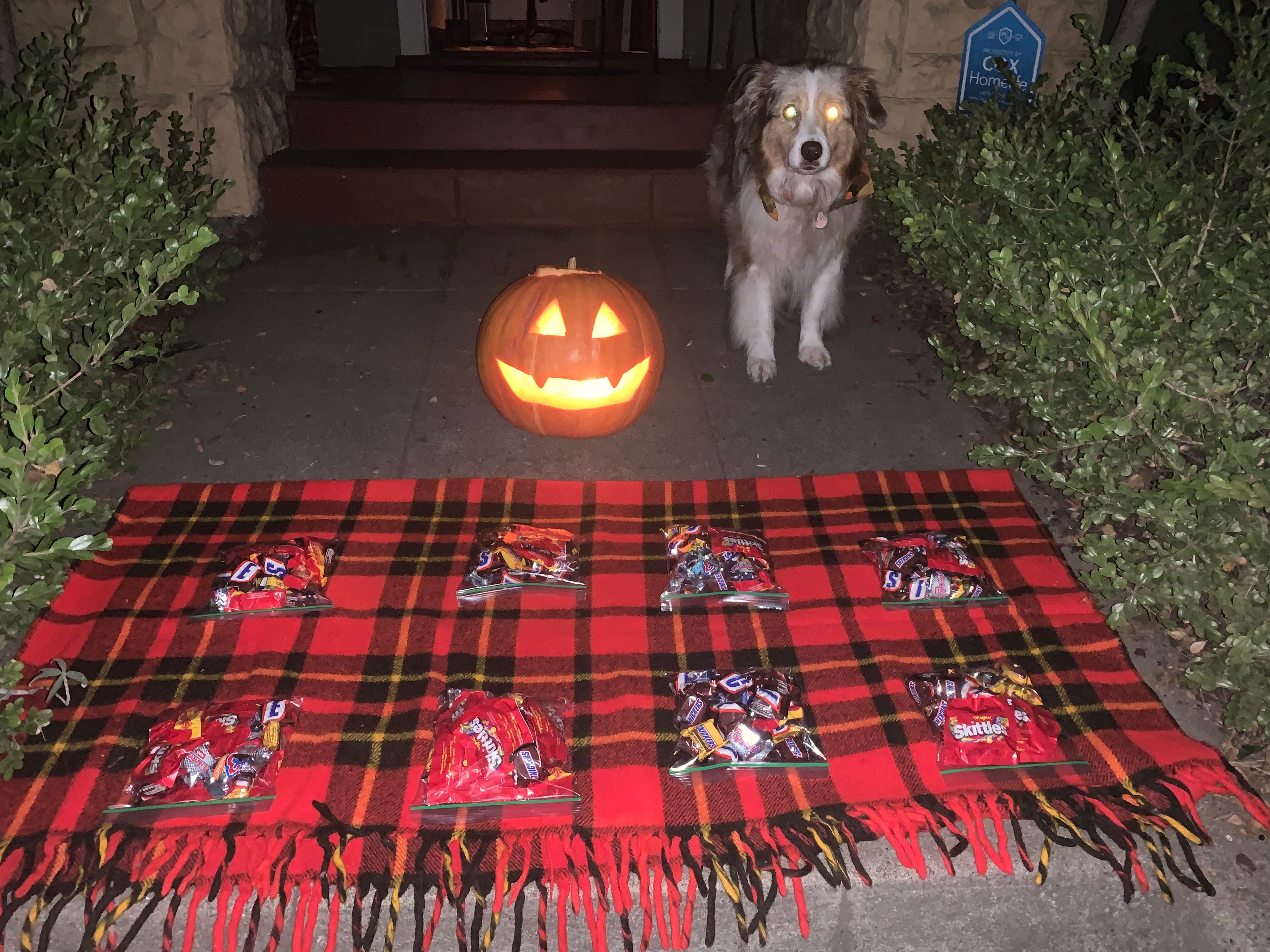
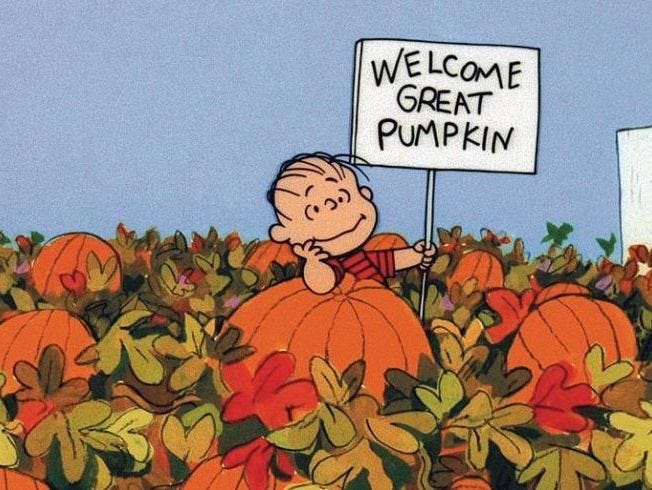
That evening on Halloween we laid out sealed baggies full of bulk candy along our driveway for distanced pickup. Indeed, a handful of children combed the neighborhood in search of sterile tricks or treats during a Covid era American holiday. Afterward, we settled in to watch our annual viewing of It’s the Great Pumpkin, Charlie Brown. I love that perennial childhood favorite as much as the Christmas special. I still get irked when Chuck gets rocks in his bag instead of candy, and I still marvel at the primitive yet impressive pastel art animation in portraying a war-torn French countryside for Snoopy’s World War One flying ace. And yep, I still admire Linus’ dedication to an abstract spiritual belief in a benevolent pumpkin deity.
At the time, I might’ve drawn a Great Pumpkin parable to the larger issue at hand, most easily metaphorical in considering the Peanuts gang’s ostracizing of Linus and his belief in a higher reward over more tangible, immediate payoffs. In the Peanuts comic strips, Linus often exhibits that clearest sign of higher intelligence: delay of self-gratification.
Something we Americans just aren’t terribly good at, to be sure.
But hey, it was just a cartoon, which is why I chose not to delve deep into some questionably stretched metaphor regarding the Peanuts gang and the American malaise of 2020. Instead, I enjoyed my memories of the show as I wolfed down some Snickers fun bite bars.
Still. If you’ve ever tossed a rock into a kid’s Halloween bag, you’re a dick.
“Ultimately, I’d like to think I’d have decided the … wasn’t worth how I’d feel if I discovered somebody died after contracting the disease from me.”
The ellipsis above carries even greater weight than what our host wrote, which was “moment in the spotlight” — my wife was speaking to her mother over the weekend about why we “still” don’t attend their indoor celebratory family meals, and the reality is that the moments of joy that we’re surely missing pale next to the concerns that we’d either or both be infecting others &/or suffering (still not completely understood, but already understood to be terrible) non-lethal side effects of a novel virus.
As she said to me afterward: “Mum expects us to change *our* actions, but none of the things that would allow us to do so have changed — neither broadly nor even in your home!”
We mask because we want others to mask, or better yet to demand clean air in schools, government buildings, etc.
🙏